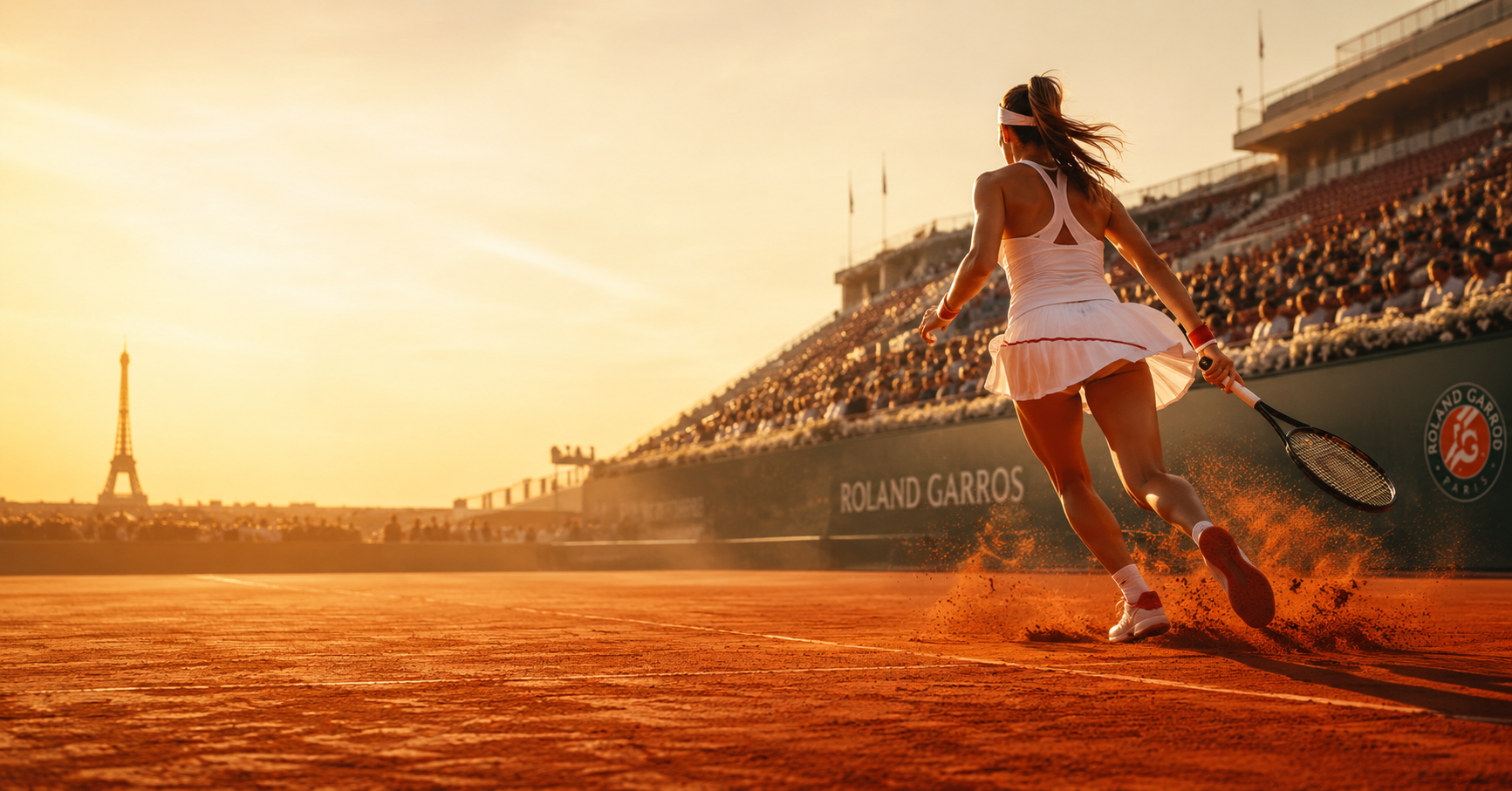
From qualifying all the way to a Grand Slam final — ten matches in Paris. In the final she lost to Mirra Andreeva 3:6, 2:6 and finishes as runner-up, but her run from the qualies remains the story of the tournament.
A self-described tennis "freak", Iga Swiatek's friend from the junior court and a player who has returned to the peak of her career after a difficult period.
Maja Chwalinska has been fascinated by tennis since childhood — she spent hours watching her idols' matches, first Roger Federer, later Rafael Nadal and Novak Djokovic. That habit of "watching tennis all day, every day" forged one of her greatest weapons: an extraordinary ability to read her opponents' game.
As a junior she won European Championship medals and played on the same team as Iga Swiatek — together they won the 2016 Junior Fed Cup, and a year later they were finalists in the junior doubles at the Australian Open. In 2021 she went through a hard time and put her career on hold for about a year and a half for health reasons, speaking openly about her battle with depression. Her current run in Paris is a story of comeback and mental strength.

It is her first ever appearance in the Roland Garros main draw (she had previously gone out in qualifying three times). In Paris she won nine matches in a row.
Why this run is impressive beyond the result alone (data: official WTA / Roland-Garros match sheets).
How does she do it? She does not play "power tennis". Instead she mixes slice, drop shots and changes of rhythm, and her biggest weapon is reading her opponents' game — the result of hours spent watching tennis as a child. She dropped her opening set only once, against Maria Sakkari, then turned the whole match around.
In the era of power tennis, Maja wins with cunning. It is the triumph of court intelligence over raw physicality — a full arsenal of slices, drop shots, lobs and changes of rhythm.

| Trait | Power tennis | Maja's style |
|---|---|---|
| Main tool | Power and topspin | Change of pace, slice, drop shot |
| Tactics | Overpowering the opponent | Breaking up the rhythm |
| Positioning | Reacting to the shot | Anticipation — moving before the ball |
| Approach | "Boom boom" — quick point | Tennis chess, geometry |
Her first coach, Pawel Kaluza, deliberately taught her an "unconventional" geometry because of her smaller frame (164 cm) — hence the drop shots, lobs and sliced balls you do not see in others. Andy Roddick noted that Maja "runs to the right spot before the ball is even struck".
Her soft, short balls cross the sideline before they reach the baseline — that forces hard-hitting opponents to run diagonally and generate their own power. For them it is a tactical nightmare. On the outside she is calm with a "poker face", though she admits herself: "inside there's a storm".
Data based on official Roland-Garros statistics. Despite losing the final, her run is already history.
The first qualifier ever in a Roland Garros final. Only the second qualifier in a Grand Slam final in the Open Era — after Emma Raducanu (US Open 2021).
The third woman in the Open Era to reach the final on her RG main-draw debut — after Evonne Goolagong (1971) and Chris Evert (1973).
The third player from outside the Top 100 in a Grand Slam final in 40 years — alongside Serena Williams (No. 181) and Raducanu (No. 150).
Six main-draw wins is as many as in her entire career to date in Grand Slam main draws.
The third Polish woman in the Open Era in a Grand Slam singles final — after Agnieszka Radwanska and Iga Swiatek.
Reaching the final projects a jump to around No. 21 WTA, and the title to around No. 14 (a seeding at Wimbledon).
The Pole's success has become a global story. The biggest names see in her the breath of fresh air the tour needed.
I love watching her play. Maja is writing history — no woman in the Open Era has gone all the way from qualifying to the final in Paris. Her creativity is pure poetry.
This is an absolute Cinderella story. Her success has a huge dimension — not only sporting, but financial too. It is a fair reward for years of fighting in the shadows.
She is a tennis freak in the best sense of the word. Her anticipation is elite. She makes every opponent feel extremely uncomfortable, because she takes away their rhythm.
We've known each other since we were 10. I'm so happy Maja has found her own path. She has earned every moment of this joy.
Maja is a tennis vampire who drinks her opponents' blood and drains all their power.
Behind the glare of the flashbulbs lies a story of enormous resilience. Maja arrived at Roland Garros with no sponsor on her shirt and no fanfare — her goal was "only" to get through qualifying.
In 2021 she made an act of great courage, publicly admitting her battle with depression. On top of that came numerous injuries — knees (surgery), wrists, adductor muscles. In Paris, because of her unexpectedly long stay, she began to worry about the hotel costs — WTA prize money is paid only after the tournament. That candid remark went around the internet within hours.
The foundation of her revival was the team that stood by her "in every circle of hell":
Before the final, Maja mentioned a "mysterious pin" — the golden badge for winners, which she is even afraid to look at. That modest artefact is the perfect metaphor for her journey: quiet and laborious, but in the end full of light.
Before Roland Garros 2026, her entire career amounted to around $864k in prize money. This single tournament has already more than doubled it.
Figures are before tax. In France the tax is around 45%, plus settlement back in Poland. The total prize purse for the tournament is around €61.7M. On top of this come new sponsorship deals and image value.
Data from the Institute for Media Monitoring (IMM, Poland) for the period 18 May – 1 June 2026.
Cunning against power. Two completely different schools of tennis and a first Grand Slam final for both players.
Key factors: Chwalinska has played 3 more matches and is dealing with adductor pain; the wind on Chatrier favours those who can manipulate the pace — and both can. Source: tournament briefing report. Final result: Andreeva won 6:3, 6:2.
Andreeva imposed an aggressive rhythm from the first game and raced ahead. Chwalinska, the stronger player in defence, mixed her pace and fought hard on return, but Andreeva — helped by a strong wind blowing on her side — controlled the rallies and surged to a 5:0 lead in the second set. The Pole salvaged two games and even saved a match point, yet after roughly an hour and a half it was over.
It is a first Grand Slam title for the 19-year-old Andreeva, coached by Conchita Martinez. Chwalinska finishes as runner-up — but with a permanent place in Roland Garros history as the first qualifier ever to reach the final.
"It sounds like a dream. Honestly, I don't know what's happening… I'm just very happy. I feel like I'm in a bubble." — Maja Chwalinska after reaching the final. Source: Reuters
"On the outside I'm calm, but inside there's a storm, believe me." — Maja Chwalinska on staying composed on court.
"I'll sleep, drink tea and watch something good. Maybe a bit of tennis, because I'm a tennis freak." — Maja Chwalinska on her recovery plan before the final. Source: rolandgarros.com
"I don't have power tennis, so I have to think on court. I know I play differently and see tennis differently from most players." — Maja Chwalinska on her style. Source: Eurosport
Answers to the questions people most often type into Google.
 Maja Chwalinska